
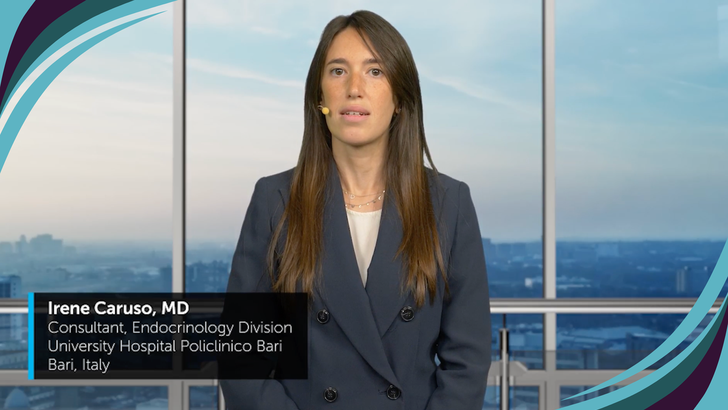
Dr. Caruso highlights how early screening programs and refined biomarkers are improving the ability to identify individuals at high risk of developing type 1 diabetes (T1D). She reviews novel immunomodulation strategies designed to slow disease progression and extend the presymptomatic stage, alongside evidence on HbA1c thresholds for better risk stratification. The session also covers promising advances in cell-based therapies, such as zimislecel (VX-880), which may transform long-term disease management. These developments underscore a shift toward earlier intervention and risk modification in T1D.
Behind the Screens: Innovations in Type 1 Diabetes Clinical Trials—From Immunomodulation to Screening Strategies and Advanced Cell Therapies

Transcript
Behind the Screens: Innovations in Type 1 Diabetes Clinical Trials—From Immunomodulation to Screening Strategies and Advanced Cell Therapies
closeTranscript
Behind the Screens: Innovations in Type 1 Diabetes Clinical Trials—From Immunomodulation to Screening Strategies and Advanced Cell Therapies
closeTranscript
Behind the Screens: Innovations in Type 1 Diabetes Clinical Trials—From Immunomodulation to Screening Strategies and Advanced Cell Therapies
closeAnnouncer:
Welcome to DataPulse from EASD 2025 on ReachMD. This activity, titled “Behind the Screens: Innovations in Type 1 Diabetes Clinical Trials—From Immunomodulation to Screening Strategies and Advanced Cell Therapies” is provided by Medcon International.
Dr. Caruso
Hello from EASD 2025 here in Vienna. I am Dr. Irene Caruso, and today I’m reviewing new insights coming from the oral session entitled Behind the Screens: New Adventures in Type 1 Diabetes Clinical Trials.
During this session, we covered the broad spectrum of type 1 diabetes research, spanning from prevention and screening to immunomodulation and cell therapy. We began with SAB-142, which is a fully human anti-thymocyte globulin which was developed to overcome the limitations of rabbit ATGs.
Preliminary data on healthy volunteers show that human ATG comes with only transient lymphopenia, avoiding permanent lymphopenia and serum sickness. These results are indeed encouraging and are likely to be expanded in future clinical trials.
Then two large studies covering screening followed. The first one, the ELSA study, was conducted in the UK and showed that on a population level, screening for islet autoantibodies was both acceptable and feasible using dried blood spots, although with some concerns regarding the inclusion of underserved groups of people.
From Germany, the Fr1da study provided long-term data on children with a single autoantibody positivity. Discussion was lively and focused on the need of risk screening these patients and also on choosing the right threshold for autoantibody levels.
Another presentation focused on risk stratification for progression to clinically overt type 1 diabetes. The analysis of the TrialNet data showed that HbA1c thresholds should be different for children and adults due to the fact that physiologically HbA1c increases with aging. Adults will require higher HbA1c levels to match their younger counterparts in terms of risk for clinically overt type 1 diabetes progression, and this will likely be included in future clinical consensus and guidelines.
Finally, the FORWARD study reported impressive results with zimislecel, which is a stem cell–derived islet transplantation. Participants no longer required insulin after 1 year of follow-up, while exhibiting excellent HbA1c and CGM metrics. While immunosuppression remains a concern, these findings highlight the extremely powerful potential of stem cell–derived islet transplantation.
Altogether, this session highlighted how much progress is being made in type 1 diabetes research, and probably the combination of these approaches will ultimately lead to a radical change in how we detect, prevent, and treat type 1 diabetes in the next few years.
From EASD 2025, that’s all. Thank you for listening.
Announcer:
Thank you for listening to this DataPulse from EASD 2025 on ReachMD. This activity is provided by Medcon International. Thank you for listening.
Ready to Claim Your Credits?
You have attempts to pass this post-test. Take your time and review carefully before submitting.
Good luck!
Overview
Provider(s)/Educational Partner(s)

Today’s healthcare environment is constantly evolving and advances of medical science occur at an accelerating pace. CME/CE plays an important role in the clinical environment and is an essential element of physician training, learning, and improvement, thereby importantly contributing to optimal patient care. Since 2000, MEDCON’s mission is to deliver high quality within the world of medical education by creating forums like PACE-CME, organizing live meetings, and providing online education. We aim to stimulate the review, exchange, and assimilation of key scientific findings to improve patients’ health, to raise awareness of new science underlying various disease states, and to accelerate the translation of this information into clinical practice.
videoEASD Highlights: Prediabetes Diagnosis, Prevalence, Misclassification Risks, and the Potential for Remission
Show more
Overview
Dr. Caruso highlights how early screening programs and refined biomarkers are improving the ability to identify individuals at high risk of developing type 1 diabetes (T1D). She reviews novel immunomodulation strategies designed to slow disease progression and extend the presymptomatic stage, alongside evidence on HbA1c thresholds for better risk stratification. The session also covers promising advances in cell-based therapies, such as zimislecel (VX-880), which may transform long-term disease management. These developments underscore a shift toward earlier intervention and risk modification in T1D.
Provider(s)/Educational Partner(s)

Today’s healthcare environment is constantly evolving and advances of medical science occur at an accelerating pace. CME/CE plays an important role in the clinical environment and is an essential element of physician training, learning, and improvement, thereby importantly contributing to optimal patient care. Since 2000, MEDCON’s mission is to deliver high quality within the world of medical education by creating forums like PACE-CME, organizing live meetings, and providing online education. We aim to stimulate the review, exchange, and assimilation of key scientific findings to improve patients’ health, to raise awareness of new science underlying various disease states, and to accelerate the translation of this information into clinical practice.
videoEASD Highlights: Prediabetes Diagnosis, Prevalence, Misclassification Risks, and the Potential for Remission
Show more
Title
Share on ReachMD
CloseProgram Chapters
Segment Chapters
Playlist:
Recommended
We’re glad to see you’re enjoying ReachMD…
but how about a more personalized experience?
